How Humans Learned to Capture Light
Photography is so deeply embedded in our daily lives that it’s easy to forget how revolutionary it once was. Today, we take thousands of photos effortlessly with our phones—but the journey to capturing the first permanent image took centuries of curiosity, experimentation, and persistence.
From Light to Image: The Earliest Ideas
Long before photography existed, people were fascinated by the behavior of light. Ancient thinkers like Aristotle observed that light passing through a small hole could project an inverted image onto a surface. This phenomenon later became known as the camera obscura (Latin for “dark chamber”).
In the 11th century, the Arab scientist Ibn al-Haytham studied optics in detail and explained how light travels and forms images. Artists of the Renaissance, including Leonardo da Vinci, used camera obscura as a drawing aid to achieve accurate perspective.
However, while these devices could project images, they could not preserve them. The missing piece was a way to make light leave a permanent trace.
The First Photograph
That breakthrough came in the early 19th century with Joseph Nicéphore Niépce, a French inventor who is widely credited with creating the world’s first photograph around 1826.
Niépce used a light-sensitive substance called bitumen spread on a metal plate. He placed the plate inside a camera obscura and exposed it to light for many hours—possibly up to 16. The result was a grainy but historic image known as View from the Window at Le Gras, the first permanent photograph ever made.
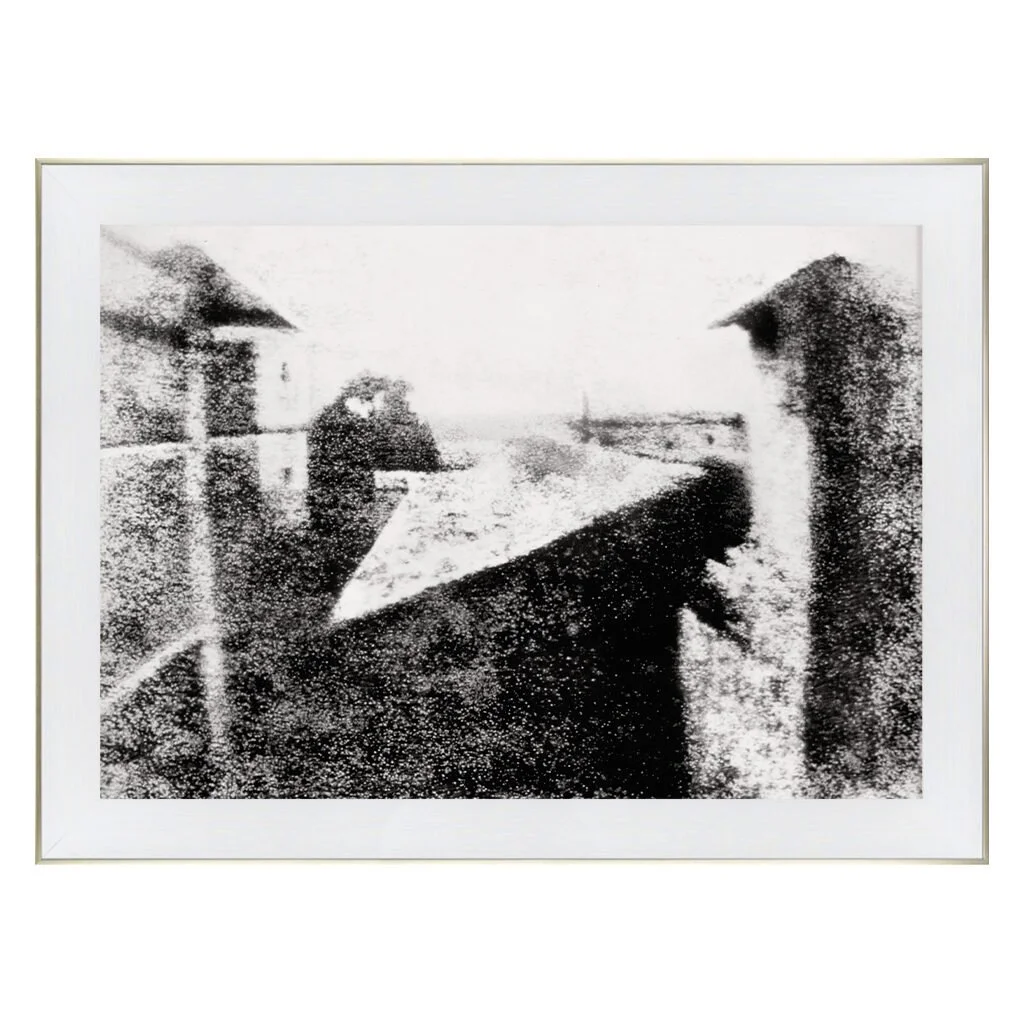
View from the Window at Le Gras - Joseph Nicéphore Niépce
Making Photography Practical
While Niépce proved that capturing images was possible, his method was slow and impractical. After his death, his collaborator Louis Daguerre refined the process and introduced the daguerreotype in 1839.
This new technique dramatically reduced exposure time and produced highly detailed images on polished metal plates. For the first time, photography became accessible to the public. However, each daguerreotype was a one-of-a-kind image—there was no negative, and therefore no way to make copies.
The Birth of Modern Photography
Around the same time, an English scientist, William Henry Fox Talbot, developed a different approach. His process, known as the calotype, introduced the concept of a negative image that could be used to produce multiple positive prints.
This innovation laid the foundation for modern film photography and, ultimately, the entire photographic industry.
A New Way of Seeing
The invention of photography changed how humans perceive and document reality. For the first time in history, moments could be captured and preserved with precision, rather than interpreted through drawing or painting.
What began as a scientific experiment evolved into an art form, a communication tool, and a universal language. From Niépce’s long exposures to today’s instant digital images, photography continues to shape how we see the world—and how we remember it.